COMMON AND FREQUENTLY ASKED QUESTIONS
What is the deliverable?
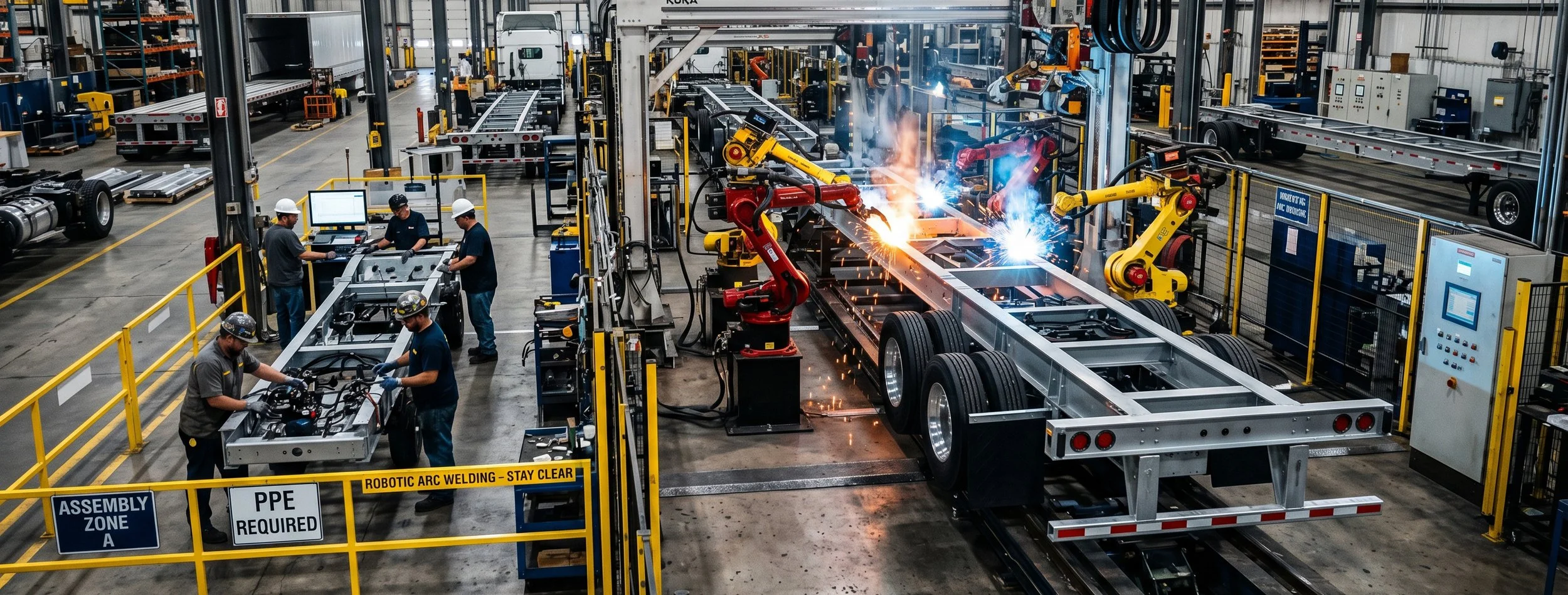
NO JACK is delivered as a pre-integrated trailer apron assembly system, installed according to application-specific requirements. We coordinate directly with apron plate suppliers to integrate the system prior to delivery to the trailer manufacturer.
This approach ensures OEM-level installation consistency, eliminates the need for aftermarket assembly-floor modifications, and supports streamlined production workflows.
The system supports up to four mounting configurations to accommodate variations in structural layout and ancillary trailer components.
Can NO JACK systems be installed into previously manufactured trailers?
NO JACK is designed exclusively for OEM integration during trailer manufacturing and is not intended for retrofit installation.
Because the system is integrated within the apron structure and interfaces with surrounding structural, pneumatic, and electrical systems, retrofit installation introduces significant structural and certification constraints.
OEM-level integration preserves:
Trailer structural integrity
Manufacturing consistency
OEM certification pathways
System-level safety validation
How does NO JACK address various apron plate thicknesses?
Apron plate thickness varies based on trailer design, payload requirements, and structural specifications.
NO JACK is engineered to integrate with apron plates ranging from 3/8 inch to 5/8 inch, aligning with standard commercial trailer construction tolerances.
Does NO JACK work with dollies and double trailers?
Yes. NO JACK is compatible with articulated multi-unit configurations, including dollies and double trailer systems.
The system engages at each trailer coupling interface and operates independently at every equipped connection point.
Is NO JACK compatible with composite trailers?
Compatibility with composite trailers depends on available structural clearance between the apron plate and the cargo floor assembly.
NO JACK requires a minimum clearance envelope of approximately 4 inches between the apron plate and cargo floor structure for proper integration.
Does NO JACK need data connections to operate?
NO JACK operates as a standalone, trailer-integrated system and does not require external telematics or network connectivity.
The system uses onboard wheel speed inputs to determine trailer motion characteristics and detect ABS activation in real time.
No data connection to the tractor or external systems is required for operation.
How is NO JACK performance validated?
NO JACK performance is evaluated through a structured validation framework that includes controlled testing, simulated operating conditions, and real-world field evaluation.
Testing is designed to replicate high-risk scenarios associated with jackknife onset, including sudden braking, low-traction environments, and dynamic roadway disturbances. System performance is measured based on its ability to maintain trailer articulation within defined, recoverable limits and prevent loss-of-control conditions from developing.
What test conditions are used to evaluate the system?
Validation protocols include a range of conditions representative of real-world operations, such as:
Low-friction surfaces (e.g., wet pavement, gravel, and reduced-traction environments)
Emergency braking and abrupt deceleration events
Varying payload distributions and trailer loading conditions
Dynamic maneuvers, including lane transitions and evasive actions
These scenarios are selected to reflect the operating environments where jackknife risk is most likely to occur.
What performance indicators are measured?
System performance is evaluated using key indicators relevant to vehicle stability and loss prevention, including:
Articulation angle control within defined thresholds
Stability during braking events
Response timing relative to ABS activation
Consistency of system engagement across operating conditions
These metrics provide a direct assessment of the system’s ability to mitigate instability at its point of origin.
Does NO JACK replace existing safety systems?
No. NO JACK is designed to complement existing safety systems, including ABS, electronic stability control, and other braking technologies.
While traditional systems respond to loss of traction or instability after it begins, NO JACK is engineered to intervene earlier—addressing the articulation condition that leads to jackknife events. This layered approach enhances overall system resilience.
Is performance data available to partners?
Performance data and validation results are made available to qualified partners under appropriate confidentiality agreements.
This includes test methodologies, performance summaries, and pilot program findings to support evaluation, underwriting analysis, and integration decisions.
How does NO JACK align with existing safety regulations?
NO JACK is designed to operate within the framework of existing commercial vehicle safety regulations. The system does not override or interfere with federally mandated braking systems, including ABS, and is engineered to function in coordination with established safety requirements.
Its role is additive—enhancing stability without altering required safety system behavior.
Does NO JACK impact FMCSA compliance?
NO JACK is designed to align with Federal Motor Carrier Safety Administration (FMCSA) guidance related to vehicle stability and safe operation.
The system maintains articulation within recoverable limits and does not impede required braking performance, supporting compliance with current operational safety expectations.
Is NO JACK compatible with OEM certification processes?
Yes. NO JACK is designed specifically for OEM-level integration and is developed to align with standard trailer manufacturing and certification processes.
By integrating at the manufacturing stage, the system supports existing OEM validation pathways, quality control standards, and production consistency requirements.
Does the system affect braking system certification?
NO JACK does not replace or modify the fundamental operation of the trailer braking system. In fail-safe conditions—such as loss of air pressure or electrical power—the system disengages and allows the trailer’s braking system to function as designed.
This ensures compatibility with established braking system certification requirements.
Are there additional regulatory approvals required?
Regulatory considerations may vary depending on jurisdiction and specific deployment configurations. NO JACK is engineered to align with existing frameworks, minimizing the need for new regulatory classifications.
Where required, we work with OEM partners and regulatory bodies to support documentation, evaluation, and approval processes.
How does NO JACK support insurer and underwriting requirements?
NO JACK provides a proactive risk mitigation mechanism that directly addresses one of the most severe loss events in commercial trucking.
By reducing the likelihood of jackknife-related incidents, the system supports:
Improved loss predictability
Reduced claim severity exposure
Enhanced underwriting confidence
Performance validation data and pilot program results can be shared with insurance partners to support actuarial evaluation and risk modeling.
I want to get involved. What is the next step?
Submit a Non-Disclosure Agreement to engage our leadership team directly. After you submit, our team will review the information and may reach out to qualified individuals or organizations to discuss alignment, intent, and potential collaboration opportunities. Approved parties will then be granted access to additional technical materials, behind-the-scenes content, and other confidential information related to the NO JACK system.